



By Jeffrey Benzing

When knee pain strikes, we tend to focus on the joint itself. However, your knees often are paying the price for what is happening (or more accurately, what isn’t happening) with your feet.
Think of your feet as the foundation of the kinetic chain. Because our bones and muscles are all interconnected, problems in the foot can cause imbalances in the knee and even contribute to problems further up the chain.
When your feet collapse inward or roll outward, they force your knees out of alignment with every step. Over time, this can create significant imbalances and excessive wear, leading to knee instability and pain.
The good news? Foot supports, such as custom-made orthotics, can properly position and stabilize your feet, restoring your body’s natural alignment.
HERE ARE SOME ISSUES FOOT SUPPORT CAN HELP CORRECT:
OVERPRONATION
When your arches collapse inward, they force the shin bone to rotate with them. This increases your Q angle: the angle between the quadriceps muscles and your knee. When the angle is too high, it causes greater biomechanical stress on the knee and maltracking of the kneecap, leading to cartilage loss and pain. Proper arch support can counteract foot and ankle collapse, allowing the knee to move smoothly.
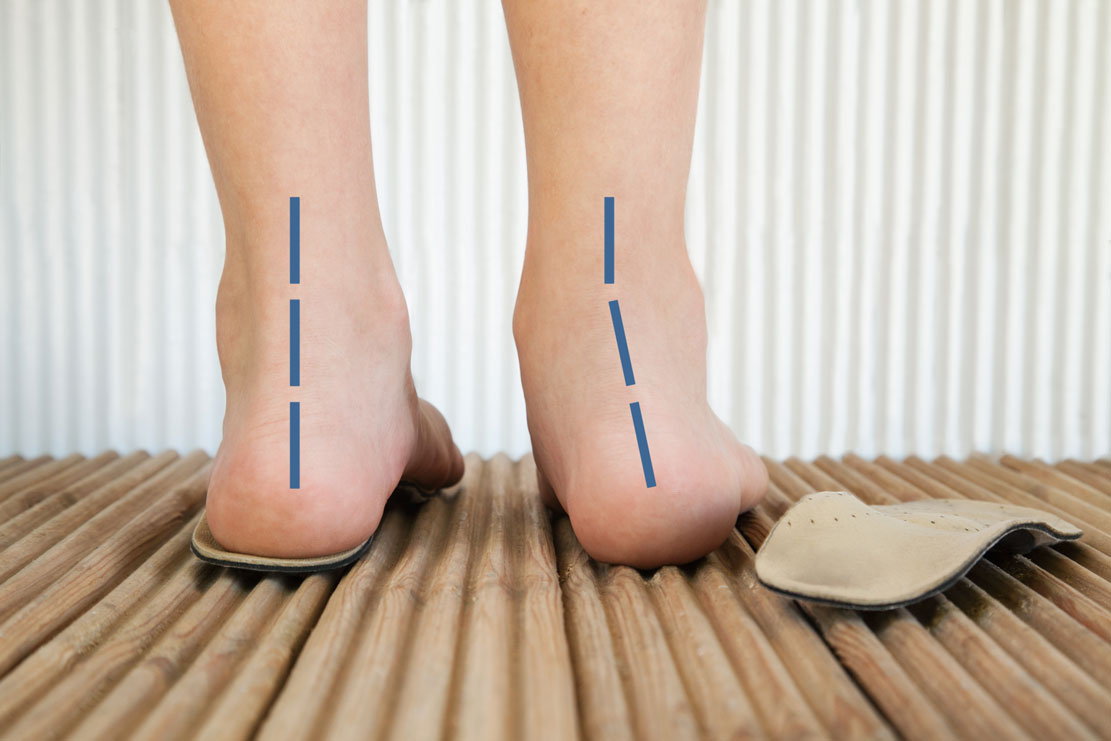
SUPINATION
High arches can cause the feet to roll outward, putting strain on the iliotibial (IT) band and causing pain on the outside of the knee. Specialized support prevents this outward roll and reduces stress on the outside of the knee.
UNEVEN LOADING
Many people distribute their weight unevenly. By correcting gait and foot biomechanics, custom orthotics distribute weight evenly across the knee joints. For example, an outer wedge can reduce pressure on the inside of the knee for those dealing with osteoarthritis.
We see problems from overpronation far more often in podiatry than supination. Thankfully, custom orthotics have been shown to be especially effective for pronation. They produce an immediate and significant reduction in the Q-angle to eliminate further knee joint damage.
A foot strengthening program also can help by building a stronger foundation. Physical therapy can address muscle imbalances and activity modification. Bracing or taping may be necessary to treat knee pain.
Don’t let a misalignment at the ground level keep you from reaching your peak. By addressing the real culprit with a podiatrist’s help, you can stop dealing with knee pain and return to living a full, active life.
Dr. Jeffrey Benzing practices podiatry at Ochsner Medical Center – Hancock. Reach him at (228) 220- 5200 or visit ochsner.org to learn more.